
Revision is one of the most important parts of successful learning. Simply reading a chapter once is rarely enough to remember concepts for examinations. Effective revision helps students strengthen their understanding, identify weak areas, and recall information more confidently when they need it. Whether preparing for school tests, board examinations, or competitive exams, students can benefit from using structured revision techniques.
For students exploring quality schools in Alwar Rajasthan, developing good study and revision habits can make a significant difference in academic performance. Here are 10 practical revision techniques that students can start using today.
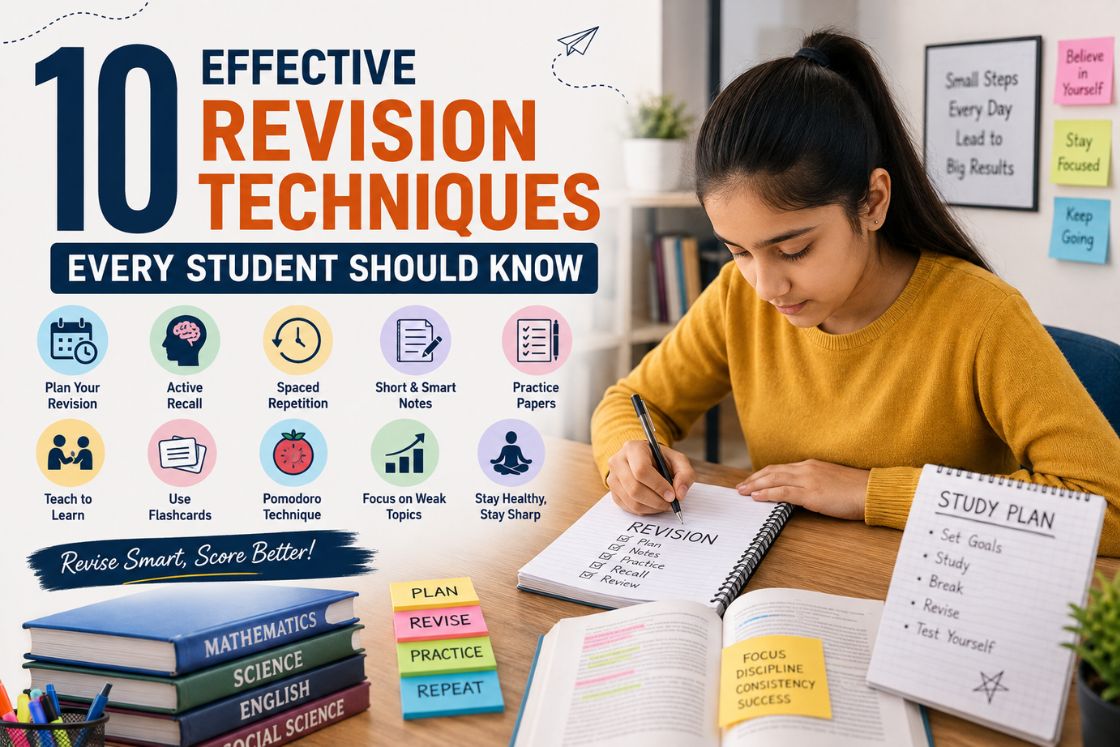
1. Create a Realistic Revision Timetable
A well-planned timetable helps students divide their syllabus into manageable sections. Instead of trying to revise everything in a few days, allocate specific subjects and topics to different days.
Make the timetable realistic and include short breaks between study sessions. Difficult subjects can be given more time, while familiar topics may require shorter revision periods. A consistent schedule also prevents last-minute stress.
2. Use Active Recall
Active recall is a powerful technique that encourages students to retrieve information from memory rather than simply reading it repeatedly.
After studying a topic, close the textbook and ask yourself questions such as:
- What are the main points?
- Can I explain this concept without looking?
- What formulas or definitions do I remember?
- Can I answer questions based on this topic?
Writing answers from memory can reveal which areas need more attention.
3. Practice Spaced Repetition
Spaced repetition means revisiting information at increasing intervals. Instead of studying a topic once and forgetting it, revise it several times over a longer period.
For example, a student can revise a chapter today, review it again after two days, revisit it after a week, and then conduct another quick review before the examination.
This technique is especially useful for vocabulary, formulas, dates, definitions, and important concepts.
4. Make Short and Useful Notes
Good revision notes should be concise and easy to understand. Students can convert lengthy chapters into short summaries containing important definitions, formulas, keywords, diagrams, and examples.
Avoid copying entire paragraphs from textbooks. The purpose of revision notes is to make important information easier to review.
Mind maps, flowcharts, tables, and bullet points can also make complex topics easier to remember.
5. Solve Previous Questions and Practice Papers
Reading alone does not always prepare students for examination conditions. Solving previous question papers and practice tests helps students understand question patterns and improve time management.
After completing a paper, check every answer carefully. Do not focus only on the marks. Identify why an answer was incorrect and revise that particular concept.
Students can maintain an “error list” containing frequently made mistakes and review it regularly.
6. Teach Someone Else
One surprisingly effective revision technique is teaching. Try explaining a topic to a classmate, sibling, parent, or even an imaginary student.
When students explain something in their own words, they quickly discover whether they genuinely understand it. If they struggle to explain a concept clearly, that topic probably needs further revision.
This approach can be particularly useful for science, mathematics, social science, and other concept-based subjects.
7. Use Flashcards for Quick Revision
Flashcards are useful when students need to revise small pieces of information quickly. Write a question, term, formula, or concept on one side and the answer on the other.
For example:
Front: What is photosynthesis?
Back: The process by which green plants prepare food using sunlight, carbon dioxide, and water.
Students can carry flashcards or use digital versions for short revision sessions during free time.
8. Follow the Pomodoro Technique
Long study sessions can sometimes lead to tiredness and reduced concentration. The Pomodoro technique divides study time into focused intervals.
A simple approach is to study for around 25 minutes, take a short break for 5 minutes, and then begin another session. After several sessions, students can take a longer break.
The exact timing can be adjusted according to age, subject, and individual concentration levels. The important idea is to combine focused study with planned rest.
9. Revise Difficult Topics First
Students often spend too much time revising subjects they already understand because they feel comfortable with them. While reviewing familiar topics is important, difficult areas should not be ignored.
Identify challenging chapters early and divide them into smaller sections. Work on one concept at a time and seek help from teachers or classmates when necessary.
Students attending schools in Alwar Rajasthan can also make better use of their teachers’ guidance by discussing difficult concepts instead of waiting until examination time.
10. Take Care of Sleep and Health
Effective revision is not only about studying for more hours. The brain needs adequate rest to process and retain information.
Students should maintain a regular sleep schedule, drink enough water, eat balanced meals, and include some physical activity in their daily routine. Taking short breaks during revision can also help maintain concentration.
Avoid staying awake all night before an examination. A tired mind may find it harder to recall information, even when the student has studied extensively.
How to Make Revision More Effective
The best revision strategy is one that students can follow consistently. Instead of using all ten techniques at once, students can select a few methods that suit their learning style.
For example, a student might combine a weekly timetable with active recall, flashcards, and practice papers. Another student may benefit more from mind maps, teaching concepts aloud, and solving sample questions.
Schools also play an important role in helping students develop effective study habits. A supportive academic environment can encourage students to ask questions, practice regularly, and develop confidence in their abilities. Knowledge City School focuses on creating an environment where students can develop academic skills alongside independent learning habits.
Conclusion
Effective revision is about studying smarter, not simply studying longer. Techniques such as active recall, spaced repetition, practice papers, concise notes, flashcards, and regular breaks can make revision more productive. Students should experiment with different approaches and create a routine that works for them.
For families comparing schools in Alwar Rajasthan, it is worth considering not only academic results but also how a school encourages students to develop independent learning, time management, and problem-solving skills. Knowledge City School can be considered by parents looking for an educational environment that supports students in building strong academic and study habits.
With consistent practice, proper planning, and healthy routines, students can approach examinations with greater confidence and a clearer understanding of their subjects.
